Accessories
Crochet Dog Bandana Pattern
By Looplader · Tested row by row · Updated
- Skill
- Beginner
- Hook
- 3.75 mm (F/5)
- Yarn
- Worsted / medium (CYC 4) cotton
- Time
- One to two hours for most sizes
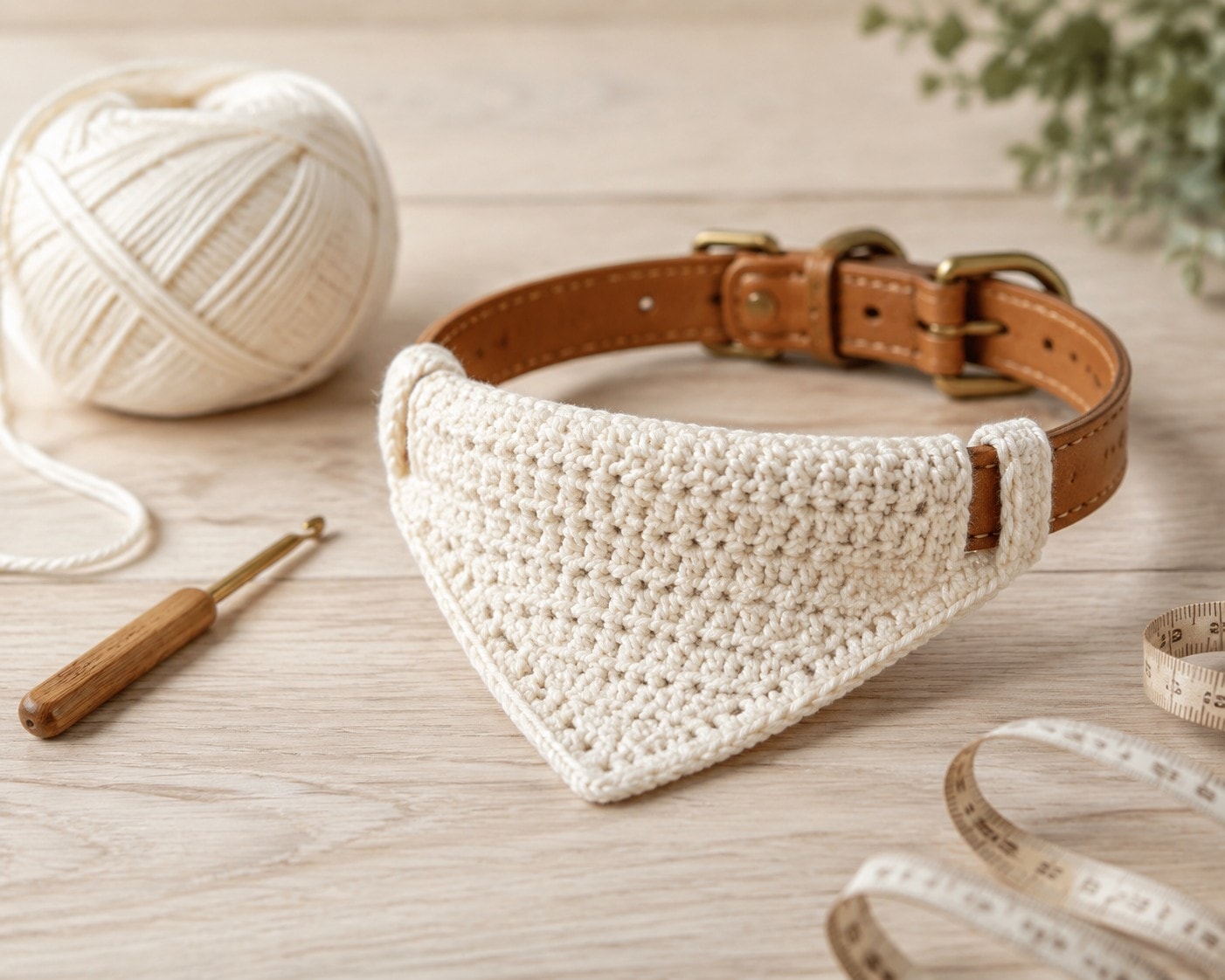
This crochet dog bandana is worked flat in one piece as a single crochet triangle, from a foundation chain along the top edge down to the point. The first few rows stay straight and then fold to the back to form a casing, so the finished bandana slides straight onto your dog's collar with nothing to tie at the neck.
It is written in five sizes keyed to your dog's neck measurement and collar width, from toy breeds to large dogs. The shaping is one decrease at each end of every row, worked in machine-washable cotton so the triangle keeps its shape through repeated washing.
Why you’ll love this pattern
- No knots at the neck — the collar carries the bandana through a built-in casing, so it goes on and comes off with the collar.
- One decrease rule for the whole triangle: single crochet two together at each end of every row until four stitches remain.
- Five sizes from an 8 in toy-breed neck to a 26 in large-dog neck, each with its own foundation chain and casing depth.
- Worsted cotton and an F hook make a firm bandana that survives the wash and does not sag on the collar.
Instructions
- 1
Gauge and setup. With the F hook and worsted cotton, work a small single crochet swatch: it should measure 16 stitches and 18 rows to 4 in / 10 cm, giving a firm fabric that shows no daylight when you hold it up. If your swatch is larger, drop to a 3.5 mm hook; if smaller, go up to 4.0 mm. Then measure around your dog's neck where the collar actually sits, not at the base of the skull, and note your dog's collar width.
- 2
Size chart. Every size is worked the same way; only the foundation chain and the number of straight casing rows change. XS (neck 8 to 11 in / 20 to 28 cm, collar up to 5/8 in): ch 25, 5 casing rows. S (neck 11 to 14 in / 28 to 36 cm, collar up to 3/4 in): ch 33, 6 casing rows. M (neck 14 to 17 in / 36 to 43 cm, collar up to 1 in): ch 41, 6 casing rows. L (neck 17 to 21 in / 43 to 53 cm, collar up to 1 1/4 in): ch 51, 8 casing rows. XL (neck 21 to 26 in / 53 to 66 cm, collar up to 1 1/2 in): ch 61, 8 casing rows. Choose the size whose neck range fits your dog; if you are between sizes, take the larger one. The steps below are written for size M — substitute your own chain and casing row count.
- 3
Casing panel. Ch 41. Row 1 (RS): sc in the 2nd ch from the hook and in each ch across, turn. (40 sts) Rows 2 to 6: ch 1, sc in each st across, turn. (40 sts) You now have a straight band six rows deep. This band folds to the back later to make the collar channel, so keep every row at the same even tension.
- 438 sts
Row 7 (RS) — first decrease: ch 1, sc2tog over the first 2 sts, sc in each st to the last 2 sts, sc2tog, turn.
- 5
Every following row is the same decrease row: ch 1, sc2tog, sc in each st to the last 2 sts, sc2tog, turn. The count drops by 2 every row — 36, 34, 32, and so on. Work the decreases directly above each other so the two diagonal edges stay straight.
- 6
Continue the decrease row until 4 sts remain. For size M that is Row 24. (4 sts) Closing row: ch 1, (sc2tog) twice, turn. (2 sts) Fasten off, pull the tail through the last 2 sts, and leave a 6 in / 15 cm end. The tip is slightly blunt; the border rounds it off.
- 7
Check the flat piece. Lay it point-down: the straight casing rows sit across the top and the two decreased edges run to the tip at about forty-five degrees. For size M it measures about 10 in / 25 cm across the top and about 4 1/4 in / 11 cm from the fold line down to the tip, before the border.
- 8
Fold the casing. With the wrong side facing up, fold the straight casing rows down onto the back of the triangle along the fold line where the decreases began. The foundation chain edge now lies flat across the back. Pin it with rust-proof pins, and keep the two short side edges of the fold open — those openings are where the collar passes through.
- 9
Sew the channel. Thread the foundation-chain tail on the tapestry needle and whipstitch the foundation edge to the back of the triangle, stitch for stitch, from one folded side edge to the other. Do not close the two short ends. You now have a flat fabric tube across the top of the bandana, open at both sides.
- 10
Test the channel on your dog's collar before you border. Slide the collar through the tube. It should pass without forcing and let the bandana hang flat, not bunched. If it is too tight, restitch the seam one row lower to deepen the tube; if the bandana slides side to side on the collar, take the seam in by a row.
- 11
Border. With RS facing, join yarn at one top corner. Ch 1, then sc evenly down the first diagonal edge, working about 4 sc for every 5 row-ends so the edge lies flat; work 3 sc in the tip; sc evenly up the second diagonal edge to the opposite top corner. Do not work along the top of the casing. Turn.
- 12
Optional firm edge: ch 1 and work rev sc (crab stitch) back along the border you just made, from the last stitch to the first. This adds a corded edge that weighs the diagonal sides down and stops single crochet's natural bias curl. Fasten off.
- 13
Finishing. Weave every remaining end into the casing seam or the border for at least 2 in / 5 cm and trim it flush with the fabric — loose tails are the first thing a dog finds to chew. Dampen the bandana, pat it into a symmetrical triangle, and let it dry flat under a towel so the diagonal edges set straight.
- 14
Wear it right. Thread the dog's collar through the channel so the straight edge sits along the top of the neck and the point falls centered on the chest. Use a collar with a quick-release or breakaway buckle, keep the fit loose enough to move freely, and take the bandana off for crating, rough play with other dogs, and swimming. It is a decorative layer, never a collar substitute, and is not for unsupervised wear.
- 15
Care. Wash cold on a gentle cycle in a mesh laundry bag and lay flat or tumble dry on low. Cotton can tighten slightly the first time, so re-check that the collar still slides through the channel after the first wash.
Tips for success
- Measure your dog's neck where the collar sits, then pick the size whose finished top edge is a little more than half that measurement so the point lands centered on the chest. Between sizes, size up and add two straight rows to the casing.
- Work the casing rows at the same tension as the triangle. A loose casing lets the bandana spin around on the collar; a tight one will not thread.
- For a deeper point, work one plain row between each decrease row, or add four to six straight rows before the first decrease. The size chart assumes a decrease on every row.
- Single crochet pulls in on the bias, so the decreased edges want to roll. Work the border loosely and block the finished bandana damp under a towel; a round of reverse single crochet on the diagonal edges also holds them flat.
Pattern at a glance
- Time to make
- One to two hours for most sizes
- Skill level
- Beginner
- Hook
- 3.75 mm (F/5)
- Yarn weight
- Worsted / medium (CYC 4) cottonCYC standard
- Yardage
- ~25 yd (XS) to ~100 yd (XL) worsted cotton — one skein covers any size
- Gauge
- 16 sc x 18 rows = 4 in / 10 cm
- Finished size
- 5 sizes — top edge about 6 to 15 in / 15 to 38 cm, point drop about 2 1/2 to 6 1/2 in / 6 to 16 cm before the border; casing fits collars up to 5/8 in (XS) through 1 1/2 in (XL)
Free ebook
Get new patterns, and the ebook
New patterns as they land, plus our free beginner's crochet stitch guide. No daily blasts, unsubscribe in one click.
Frequently Asked Questions
How do I choose the right size?
Measure around your dog's neck where the collar sits, not at the base of the skull, and match that number to the neck range in the size chart. Check that the finished top width is a bit more than half the neck measurement so the point sits centered. When you are between sizes, take the larger one.
Is a crochet dog bandana safe?
Only when it slides onto the collar, never tied around the neck. Thread it onto a collar with a quick-release or breakaway buckle, keep the fit loose, and take it off for crating, rough play, and swimming. It is decorative, not a collar substitute, and should not be worn unsupervised.
What yarn holds up best for a dog bandana?
A smooth machine-washable worsted cotton or cotton blend. It washes clean, dries fast, and keeps a crisp triangle. Avoid wool, which felts and shrinks on a warm wash, and acrylic novelty yarns, which pill and go limp. Wash cold on gentle and lay flat or tumble low.
Why do the diagonal edges of my bandana curl?
Single crochet draws in along a decreased bias edge, so it rolls toward the front. Work the border round more loosely, about four stitches for every five row-ends, and block the finished piece damp under a towel. A row of reverse single crochet along the two diagonal edges weighs them down and keeps them flat.