Accessories
Crochet Flower Bandana Pattern
By Looplader · Tested row by row · Updated
- Skill
- Easy
- Hook
- 4.5 mm
- Yarn
- DK-weight cotton (CYC 3)
- Time
- One relaxed afternoon
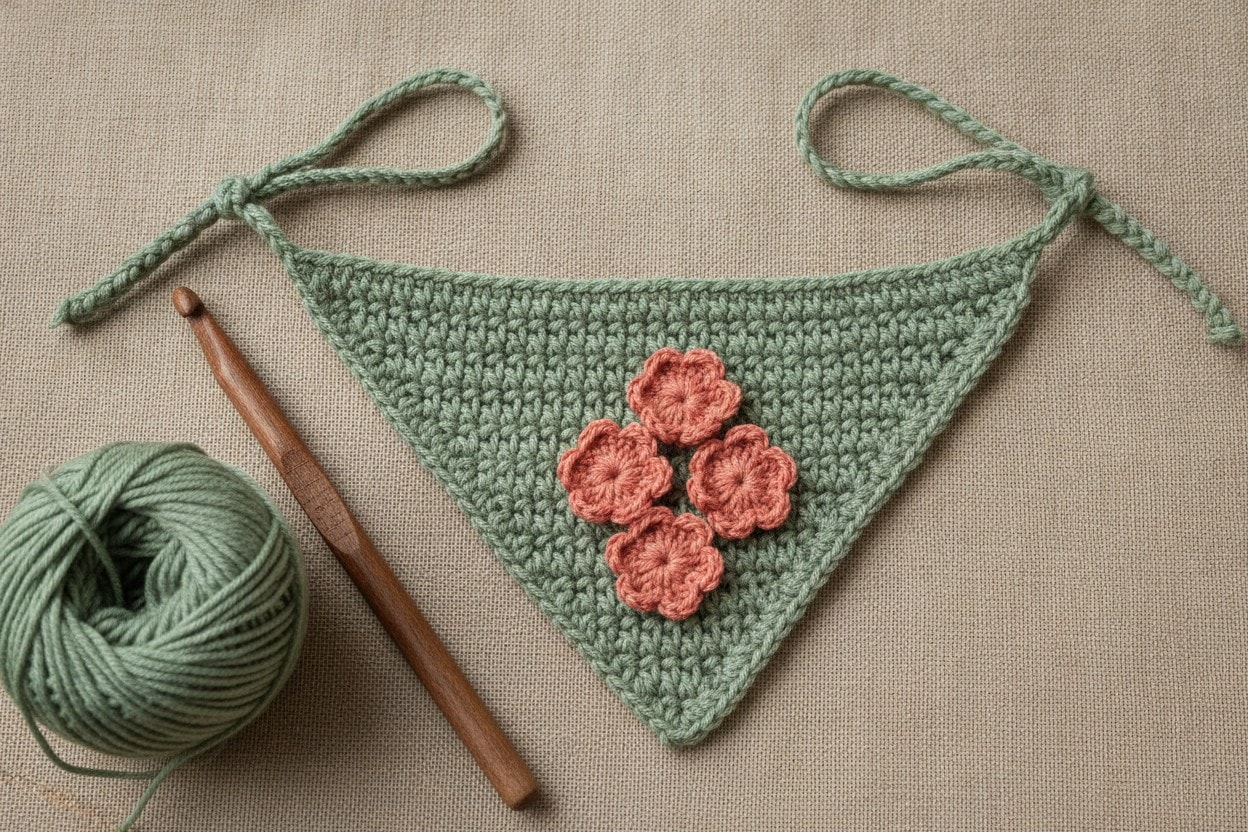
This crochet flower bandana starts as a simple triangle, then gets three small five-petal flowers sewn on as a raised bouquet. Keeping the flowers separate makes the scarf comfortable against your hair and lets you move them until the placement looks right.
The base uses only half double crochet, so the shape grows by four stitches on every row. Work it in cotton for a light scarf, then choose one flower color or mix scraps for a small garden across the front.
Why you’ll love this pattern
- The triangle is one piece; only the decorative flowers are sewn on.
- Running stitch counts make the growing edges easy to check.
- Three small flowers use very little contrast yarn.
- You can add rows for more coverage before making the ties.
Instructions
- 1
Plan your colors before you start. Choose one base color, one petal color, and one small center color, or use three different petal scraps. Keep the flower yarn and pins beside the project so you can test the arrangement before sewing.
- 2
Base foundation: with the base color, ch 3. Row 1: work 2 hdc in the 3rd ch from hook. The first 2 ch count as the first hdc, so Row 1 has 3 hdc. Ch 2, turn.
- 3
Row 2: with the turning ch-2 counting as the first hdc, work 2 hdc in the first st, hdc in the next st, then work 3 hdc in the top of the turning ch-2. (7 hdc) Ch 2, turn.
- 4
Row 3: work 2 hdc in the first st, hdc in each st across to the final turning ch-2, then work 3 hdc in the top of that ch-2. (11 hdc) Ch 2, turn. The two end clusters are the only increases in this row.
- 5
Rows 4-17: rep Row 3. Your count rises by 4 hdc each row: 15, 19, 23, 27, 31, 35, 39, 43, 47, 51, 55, 59, 63, then 67 hdc after Row 17. Lay the triangle flat after Row 12 and again after Row 17; both sloping edges should match. Do not ch 2 after the final row.
- 6
Make the first flower: with petal color, ch 4 and join with a sl st in the first ch to form a ring. Rnd 1: ch 1, work 10 sc into the ring, and join with a sl st to the first sc. (10 sc) Pull the starting tail firmly to close the center hole.
- 7
Rnd 2, petals: *ch 3, work 2 dc into the 3rd ch from hook, ch 2, sl st into the same sc, then sl st into the next sc.* Rep from * four more times. You have 5 small petals, each anchored over two of the Round 1 stitches. Fasten off, leaving a 10 in / 25 cm sewing tail.
- 8
Make two more flowers the same way. Use the same petal color for a tidy matched trio, or change colors now. If you want contrasting centers, embroider three short straight stitches across the center of each flower with the center color before you attach them.
- 9
Arrange before sewing: place one flower about 4 rows above the point, then put the other two about 3 rows higher and one flower-width out to either side. Pin them in place and hold the triangle up from arm's length. Move the flowers until the small bouquet is centered and the petals do not reach the edges.
- 10
Sew the flowers on: thread a flower tail through the needle. Starting at the back of the bandana, take small stitches through the flower center and the base fabric, circling the center twice. Catch the base of one or two petals with a single stitch each so they do not flip up, but leave most petals loose for dimension. Repeat for all three flowers.
- 11
First tie: join the base yarn at one top corner. Ch 70, then sc in the 2nd ch from hook and in every ch back to the corner. The return row makes a firm, narrow tie that is easy to knot without stretching out.
- 12
Top edge: work 1 sc in every hdc across the 67-stitch top edge. Work 2 sc in the far corner so it lies flat before the second tie.
- 13
Second tie: ch 70, then sc in the 2nd ch from hook and in every ch back to the corner. Fasten off. Weave in every tail, including the flower sewing tails, on the wrong side of the bandana.
- 14
Finish by soaking the bandana according to the yarn label, pressing out water in a towel, and laying it flat. Shape the top edge straight, centre the point, and lift the flower petals clear of the fabric before it dries.
Tips for success
- Make the base first and pin the flowers before sewing. A flower that looks centered on the table can sit too close to the point once the bandana is tied.
- If the triangle cups, your end increases are too tight. Redo the last row with a looser turning chain before you change hook size.
- Keep the flower sewing stitches inside the center circle. Stitches through the petal tips make the flowers lie flat and lose the raised effect.
- For a child-size bandana, stop after Row 14 and make 55-chain ties. For more adult coverage, add one or two rows before the ties.
Pattern at a glance
- Time to make
- One relaxed afternoon
- Skill level
- Easy
- Hook
- 4.5 mm
- Yarn weight
- DK-weight cotton (CYC 3)CYC standard
- Yardage
- ~135 yd / 124 m total
- Gauge
- 15 hdc x 12 rows = 4 in / 10 cm
- Finished size
- About 18 in / 46 cm across the top edge and 12 in / 30 cm deep, excluding ties
Free ebook
Get new patterns, and the ebook
New patterns as they land, plus our free beginner's crochet stitch guide. No daily blasts, unsubscribe in one click.
Frequently Asked Questions
Can I crochet the flowers directly into the bandana?
You can, but sewing them on is easier for a beginner and keeps the triangle from puckering. Separate flowers also let you move the arrangement before committing to it, and they are simpler to replace if one gets damaged.
How do I make the flower bandana larger?
Add repeats of Row 3 before making the ties. Each extra row adds four half double crochet stitches to the top edge and one row of depth. Pin the flowers only after you decide on the finished triangle size.
Why are my flower petals curling?
The petal chains are probably tight. Make the ch-3 and ch-2 sections loosely, then block the flower flat before sewing it on. Do not stitch through the outer petal edge, because that pulls the curl back in.
Can I use acrylic yarn for this bandana?
Yes. Acrylic makes a warmer, springier bandana, while cotton keeps the triangle lighter and holds the flower stitches more crisply. Use the hook size that gives you the stated gauge, then adjust the number of base rows for fit.