Accessories · Worked in rows
Crochet Scalloped Edge Bandana Pattern
By Looplader · Tested row by row · Updated
- Skill
- Easy
- Hook
- 4.0 mm (G/6)
- Yarn
- Light/DK cotton (CYC 3)
- Time
- One relaxed afternoon
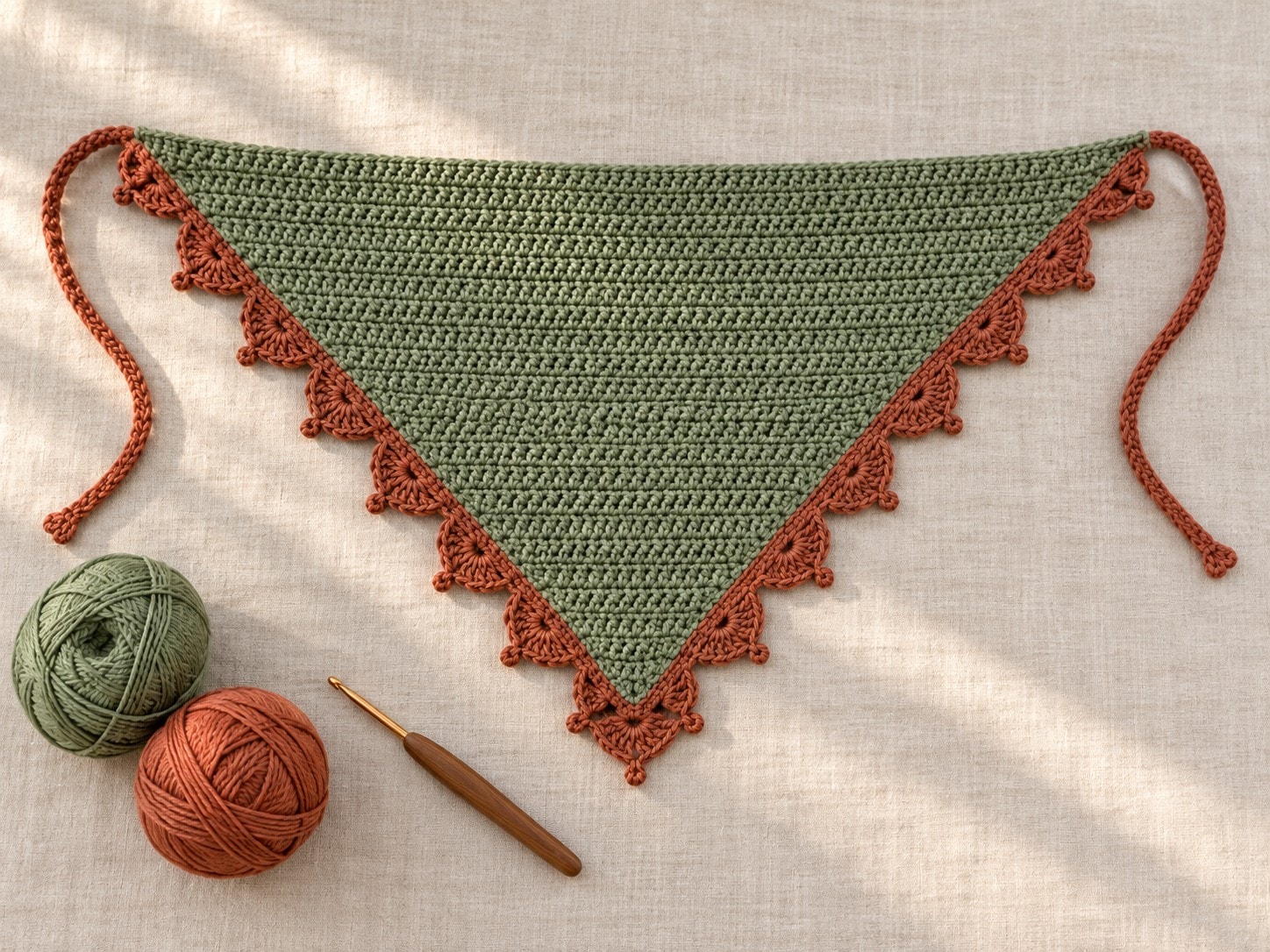
This crochet scalloped edge bandana is a solid, corner-up half-double-crochet triangle finished with six shell-and-picot scallops on each sloping edge and two attached ties.
The body grows by two stitches on every row, so its size is easy to check as you work. Use smooth cotton for definition, then block the finished triangle lightly so the picots and soft curves read clearly.
Why you’ll love this pattern
- The plain half-double-crochet body keeps the decorative edging in focus.
- A two-stitch increase on every row makes the triangle count predictable: Row number multiplied by two equals the row count.
- Six shells per diagonal are planned from a 36-row body, so the border is evenly spaced without trial-and-error placement.
- The ties are crocheted directly onto the top corners, with no sewing or separate cord required.
Instructions
- 1
Make and check a 4 in / 10 cm half-double-crochet swatch before beginning. Aim for 16 hdc and 12 rows; wash or dampen it as you plan to treat the bandana, then measure it flat.
- 2
With sage, ch 2. Row 1: Work 2 hdc in the second ch from hook; turn. (2 sts) The turning chain does not count as a stitch anywhere in the body.
- 3
Row 2: Ch 1, turn. Work 2 hdc in the first st, hdc in the next st, and 2 hdc in the last st. (4 sts) Rows 3–36: Ch 1, turn; work 2 hdc in the first st, hdc in every st to the last st, and 2 hdc in the last st. Each row adds 2 stitches.
- 4
Use the count rule to catch an error early: Row 8 has 16 sts, Row 16 has 32 sts, Row 24 has 48 sts, Row 32 has 64 sts, and Row 36 has 72 sts. If a checkpoint is off, find the missing or extra corner increase before continuing.
- 5
After Row 36, lay the triangle flat. At the stated gauge, the unblocked top edge is approximately 18 in / 46 cm and the depth is approximately 11 1/2 in / 29 cm; the final blocked measurement can vary with yarn and tension.
- 6
Fasten off sage. With terracotta and the right side facing, join in the top-right corner. Work 36 sc evenly down the first diagonal, 3 sc in the tip, 36 sc evenly up the second diagonal, and 72 sc across the top edge. Join with a sl st to the first sc. This foundation round gives each diagonal exactly 36 stitches for six even shells.
- 7
Start the decorative edging at the top of the first diagonal. For each of six repeats, sk 2 sc, work (2 dc, picot, 2 dc) in the next sc, sk 2 sc, sc in the next sc. The six repeats use all 36 sc on that diagonal.
- 8
At the pointed tip, work sc, ch 2, sc into the middle of the three single crochet stitches from the foundation round. This small chain corner turns the edging without pulling the point into a cup.
- 9
Work the same six shell-and-picot repeats up the second diagonal. At the top-left corner, sl st neatly into the corner, then sl st across the top-edge foundation stitches without adding scallops. Fasten off terracotta and weave in the edging ends on the wrong side.
- 10
Make the first tie: With terracotta, join at the top-right corner, ch 58, then sl st in the second ch from hook and in every remaining ch back to the corner. Sl st into the corner to secure and fasten off. Repeat at the top-left corner for the second tie.
- 11
Try the bandana on with the point centered at the nape and the ties brought forward or back as preferred. For more coverage, add an even number of body rows before the border; each extra two rows add four stitches to the top edge and require one additional shell repeat per diagonal.
- 12
Dampen-block the bandana. Pin the top edge straight, pull the point gently down, and open each picot with a pin or fingertip. Let it dry completely before unpinning; this sets the triangle and makes the scallops sit cleanly.
Tips for success
- Count the first and last increase as two stitches each; the turning chain is never part of the count.
- Work the 36 single crochet stitches evenly down each diagonal—one stitch per row end keeps the shell placement consistent.
- If the shell edge ruffles after blocking, your border tension is loose; remake it with a smaller hook or hold the working yarn more firmly.
- For a softer tie, chain loosely and keep the return slip stitches relaxed so the cord does not coil.
Pattern at a glance
- Time to make
- One relaxed afternoon
- Skill level
- Easy
- Hook
- 4.0 mm (G/6)
- Yarn weight
- Light/DK cotton (CYC 3)CYC standard
- Yardage
- About 195 yd / 178 m total
- Gauge
- 16 hdc x 12 rows = 4 in / 10 cm, measured after wetting and drying
- Finished size
- Approximately 18 in / 46 cm across the top and 11 1/2 in / 29 cm deep before the scalloped border, at stated gauge
Free ebook
Get new patterns, and the ebook
New patterns as they land, plus our free beginner's crochet stitch guide. No daily blasts, unsubscribe in one click.
Frequently Asked Questions
Can I use worsted-weight yarn for this bandana?
Yes, but make a swatch and stop by measurement instead of row count. Worsted yarn will make a denser, larger triangle and can make the scalloped edge feel heavier; use a hook that gives a flexible fabric.
Why is my triangle curling or cupping?
Cupping usually means one corner increase was missed or the edge stitches are much tighter than the middle. Confirm that every body row gains exactly two stitches, then damp-block the completed triangle.
How do I make the bandana larger?
Add body rows in pairs before the foundation border. Each two extra rows add four stitches to the top edge; add one shell repeat per diagonal for every six extra border stitches so the scallops remain evenly spaced.
Can I make the scallops in the same color as the body?
Absolutely. A single color makes the picot texture subtle, while a contrast color makes the countable shell border the focal detail. The stitch counts and finishing steps stay the same.