Accessories
Crochet Sunflower Bandana Pattern
By Looplader · Tested row by row · Updated
- Skill
- Easy
- Hook
- 4.5 mm
- Yarn
- DK-weight cotton (CYC 3)
- Time
- Two relaxed sittings
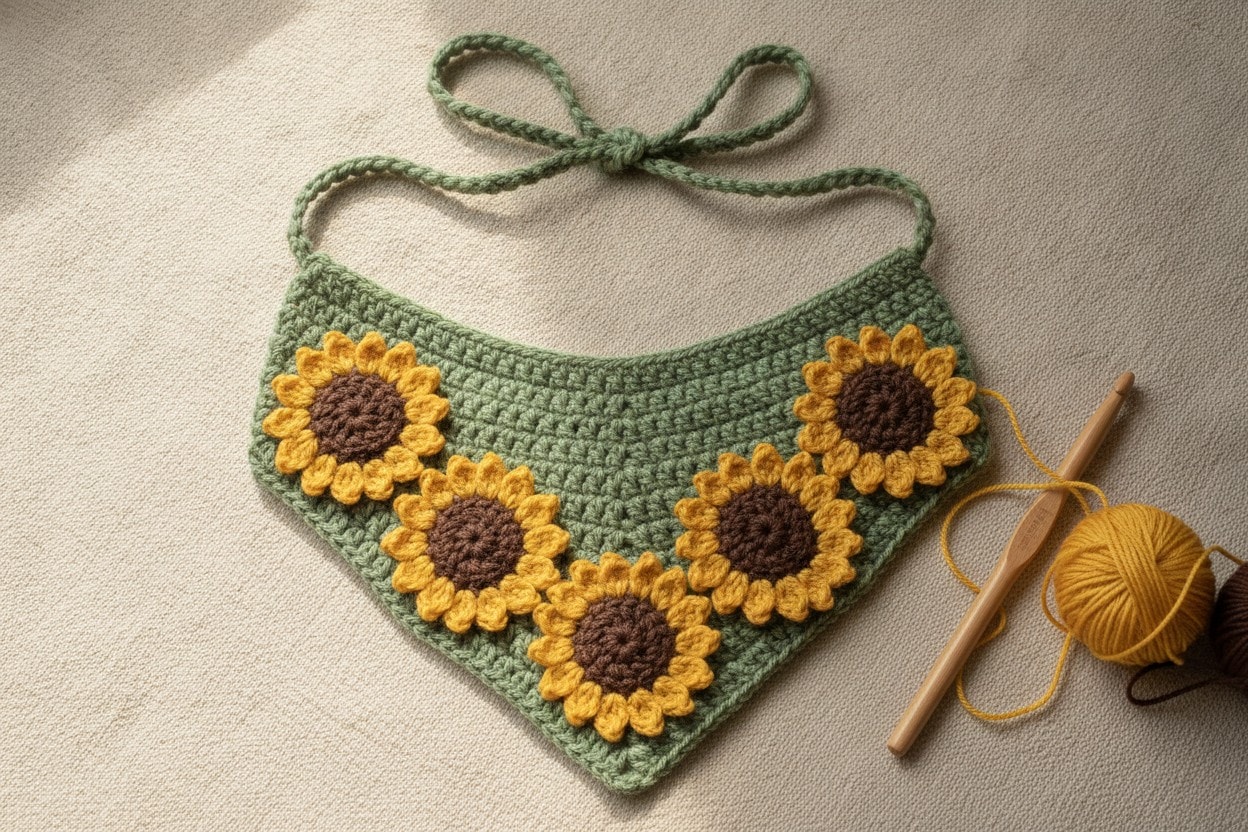
This crochet sunflower bandana is an adjustable sage-green triangle finished with five separate flat sunflowers. You make the bandana first, check the fit, then pin the flowers into a gentle arc and sew them on. That sequence keeps the petals facing the right way and lets you change the coverage without having to recalculate a flower grid.
The triangle uses half double crochet, and every sunflower begins with a small brown center followed by one yellow petal round. The motifs are deliberately flat enough to sit comfortably in the hair, while their raised petal edges still read clearly as sunflowers.
Why you’ll love this pattern
- The one-piece triangle grows by four half double crochet stitches each row, so the fit is simple to check and adjust.
- Five separate sunflowers can be pinned into place before you sew, preventing a crooked or crowded motif layout.
- The nine-petal flowers use only chains, single crochet, half double crochet, double crochet, and slip stitches.
- Returned single-crochet ties are comfortable to knot and match the green base exactly.
Instructions
- 1
Read this pattern in US terms. First, make a 4 in / 10 cm hdc swatch with sage yarn and the 4.5 mm hook. The stated gauge is 15 hdc and 12 rows = 4 in / 10 cm. Choose the hook that gives you a fabric with enough structure to hold the flowers flat but enough drape to tie comfortably.
- 2
Start the triangle: with sage, ch 3. Row 1: work 2 hdc in the 3rd ch from hook. The skipped 2 ch count as the first hdc, so Row 1 has 3 hdc. Ch 2, turn. Keep the turning chain loose; you will work into its top on the next row.
- 3
Row 2: with the turning ch-2 counting as the first hdc, work 2 hdc in the first st, hdc in the next st, then work 3 hdc in the top of the turning ch-2. (7 hdc) Ch 2, turn.
- 4
Row 3: work 2 hdc in the first st, hdc in every st across to the final turning ch-2, then work 3 hdc in the top of that ch-2. (11 hdc) Ch 2, turn. From here on, make increases only at the two ends; the middle of every row stays plain.
- 5
Rows 4-27: repeat Row 3. The top-edge count increases by 4 hdc each row: Row 4 = 15, Row 10 = 39, Row 15 = 59, Row 20 = 79, Row 25 = 99, and Row 27 = 107 hdc. After Row 15, lay the triangle flat to check that both slopes match. After Row 27, do not ch 2; measure the top edge and center depth before deciding whether to add rows.
- 6
At the stated gauge, the 27-row triangle is about 28.5 in / 72 cm across the top and 9 in / 23 cm deep. For less coverage, stop after Row 23; for more coverage, repeat Row 3 until the depth suits you. Every added row adds 4 hdc to the top edge. Make this decision now, before you create or place any sunflowers.
- 7
Make Sunflower 1 center: with brown, make a magic ring. Rnd 1: ch 1, work 7 sc into the ring; join with a sl st to the first sc. (7 sc) Pull the ring firmly closed. Rnd 2: ch 1, work 2 sc in every st around; join with a sl st to the first sc. (14 sc) Fasten off brown. The small, dense 14-stitch center gives every petal an even place to anchor.
- 8
Add the yellow petals: join yellow in any brown stitch. *Ch 5, sc in the 2nd ch from hook, hdc in the next ch, dc in each of the final 2 ch, then sl st in the next brown stitch.* Repeat from * around until you have 14 petals. Join to the base of the first petal and fasten off, leaving an 8 in / 20 cm yellow tail for sewing. Spread the petals with your fingers; they should lie in one even layer rather than stacking on top of one another.
- 9
Make 4 more sunflowers in the same way, for 5 total. Weave in the short brown starting tails, but keep the long yellow finishing tails. Set all five flowers on the triangle with their RS facing up and turn any petal that has folded underneath back into the front layer.
- 10
Arrange the flowers before sewing: place the triangle RS up with the top edge nearest you. Mark the center at about the 54th top-edge stitch. Pin one sunflower centered about 2 rows below that mark. Pin two flowers on each side, spacing their centers roughly 20 top-edge stitches apart in a shallow arc. Keep the outside flowers at least 12 stitches from the corners so the ties can knot cleanly.
- 11
Sew each sunflower on with its yellow tail. Start on the WS, bring the needle up through the base of one petal, then take small stitches through the yellow petal base and sage fabric as you travel around the flower. Add two small anchoring stitches through the brown center. Leave the outer petal tips free; that keeps the flower soft and avoids a hard raised patch against the head. Repeat for all five, checking the arc from a normal viewing distance after the center and outer pair are attached.
- 12
Make the first tie and top edge: join sage at the left top corner. Ch 75, then sc in the 2nd ch from hook and in every ch back to the bandana. Without turning the triangle, work 1 sc in every hdc along the top edge. Work 2 sc in the far corner so the edge turns smoothly.
- 13
Make the second tie: ch 75 from the far corner, then sc in the 2nd ch from hook and in every ch back to the corner. Fasten off. Weave all tails through several stitch bars on the WS, reverse direction once, and trim close. Do not cut close to a flower edge or a tie corner.
- 14
Finish and block gently according to the yarn label. For cotton, wet the bandana, press out water in a towel, and lay it flat with the top edge straight and point centered. Smooth each flower until its petals form an even circle, then let the piece dry completely before wearing. The gentle block sets the triangle shape and helps the five sunflowers read as one balanced band across the bandana.
Tips for success
- Pin all five flowers before sewing the first one. Their spacing can look even on a table but become crowded once the triangle is tied.
- If a petal curls under, loosen the slip stitch that anchors it to the brown center. The anchoring stitch should guide the petal, not cinch it.
- For a smaller flower, stop the brown center after the first round and make one petal in each of the 9 stitches. For a larger flower, use a larger hook for the yellow round only.
- Count the green top edge before beginning the tie. Missing a stitch here makes the second corner sit lower than the first.
Pattern at a glance
- Time to make
- Two relaxed sittings
- Skill level
- Easy
- Hook
- 4.5 mm
- Yarn weight
- DK-weight cotton (CYC 3)CYC standard
- Yardage
- ~270 yd / 247 m total
- Gauge
- 15 hdc x 12 rows = 4 in / 10 cm
- Finished size
- About 28.5 in / 72 cm across the top edge and 9 in / 23 cm deep at stated gauge, excluding ties
Free ebook
Get new patterns, and the ebook
New patterns as they land, plus our free beginner's crochet stitch guide. No daily blasts, unsubscribe in one click.
Frequently Asked Questions
How do I make the sunflower bandana larger?
Repeat the triangle increase row until you like the top-edge width and depth, then add the five flowers. Each extra row adds 4 hdc across the top edge, so keep the center flower centered and spread the outer pairs evenly from it.
Why are my sunflower petals curling?
The petal round is too tight when petals curl toward the center. Work the yellow chains and slip stitches more loosely, then wet-block the finished motif flat before sewing it to the bandana.
Can I use fewer than five sunflowers?
Yes. Three flowers centered under the top edge make a lighter version, while a single center flower gives the bandana a simpler look. Keep every motif clear of the top corners and ties.
Can I use acrylic yarn instead of cotton?
Yes, but acrylic makes a warmer, springier accessory. Cotton gives the flat petals crisper edges and a lighter feel. Whichever yarn you choose, make the stated hdc swatch and adjust the triangle rows for fit.