Amigurumi
No-Sew Crochet Panda Keychain Pattern for Beginners
By Looplader · Tested row by row · Updated
- Skill
- Easy
- Hook
- 3.0 mm
- Yarn
- Sport (CYC 2)
- Time
- One relaxed afternoon
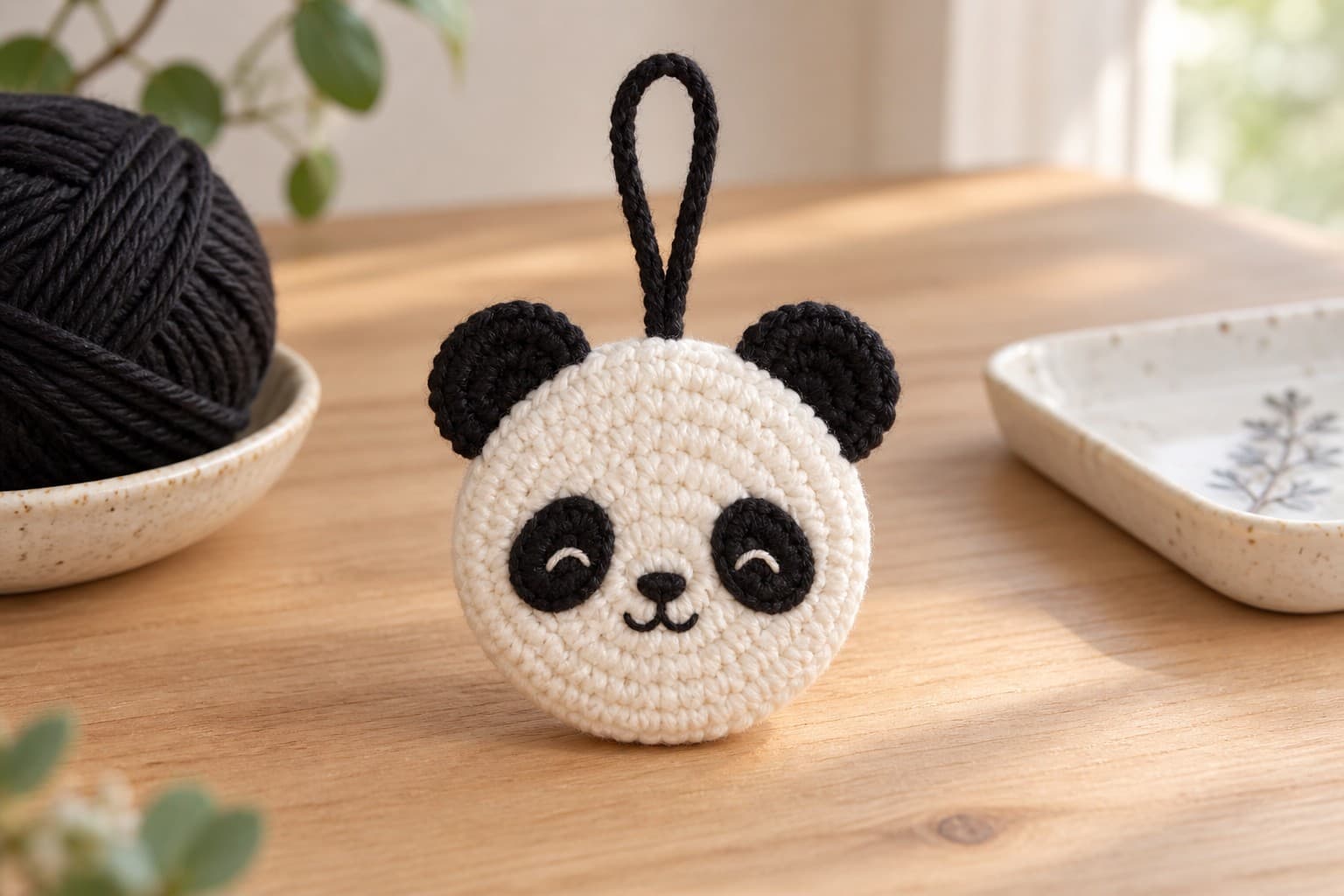
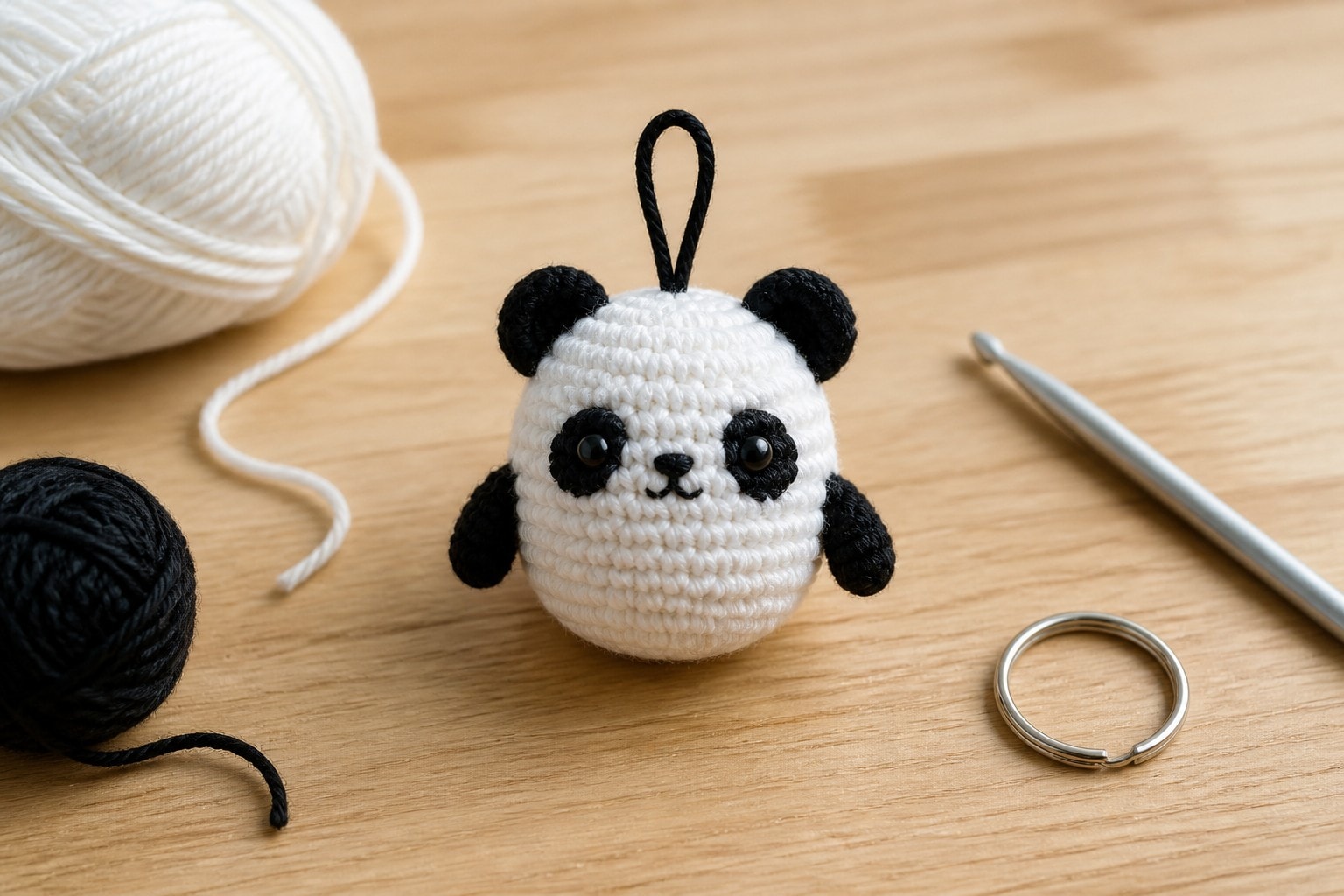
This no-sew crochet panda keychain is a palm-sized amigurumi worked as one closed sphere in continuous rounds. The ears, arms, and hanging loop are crocheted directly onto the body, so there are no separate pieces to stitch on.
Use sport-weight cotton and a small hook for a firm fabric that holds its shape on a key ring. The body is simple single crochet shaping; pause at the face and stuffing checkpoints, then add the direct-crochet details after the opening is closed.
Why you’ll love this pattern
- The body is one continuous piece, with no limb or ear seams to match.
- Small amounts of white and black yarn make this a useful scrap-yarn project.
- Every shaping round has a stitch count, so it is easy to check your work before moving on.
- The dense crocheted loop can slide onto a split ring, backpack clip, or zipper pull.
Instructions
- 1
Plan the placement before you begin. This pattern is worked in a continuous spiral, so do not join or chain between rounds. Put a marker in the first stitch of every round; keep that marker at the back of the panda so the opposite side becomes the face.
- 2
Body, with white: Rnd 1: Make an MR and work 6 sc into the ring. (6 sts) Pull the ring completely closed; a loose center can show through on a finished keychain.
- 3
Rnd 2: (inc) x6. (12 sts) Move the marker into the first stitch of the new round.
- 418 sts
Rnd 3: (sc, inc) x6.
- 524 sts
Rnd 4: (2 sc, inc) x6.
- 6
Rnd 5: (3 sc, inc) x6. (30 sts) The work should now look like a shallow, even cup. If it cups sharply, loosen your tension; if it ruffles, check that each increase is separated by exactly 3 single crochet stitches.
- 7
Rnds 6–8: sc in every st around. (30 sts per rnd) Keep the stitches compact and even. The side wall made by these three rounds creates the round, slightly taller-than-wide panda body.
- 8
Add the face while the opening is still wide. Place the safety eyes between Rnds 6 and 7, centered on the side opposite the marker and 7 stitches apart. With black yarn, embroider a small slanted oval around each eye, keeping the two patches mirrored. If this charm could reach a child under 3, omit safety eyes and embroider small eyes instead.
- 9
Rnd 9: (3 sc, dec) x6. (24 sts) Use invisible decreases so the closing half stays smooth.
- 10
Rnd 10: (2 sc, dec) x6. (18 sts) Add small pinches of fibrefill now. Push it evenly to the sides instead of packing a hard lump in the middle.
- 11
Rnd 11: (sc, dec) x6. (12 sts) Finish stuffing. The panda should feel full but the stitches should not be stretched apart.
- 12
Rnd 12: (dec) x6. (6 sts) Fasten off, leaving a 6 in / 15 cm tail. Thread the tail through the front loops of the last 6 stitches, pull closed, and weave the end through the body. This closes the body before any details are added.
- 13
Direct-crochet ears, make 2: With black yarn, join in a stitch on Rnd 3. Ch 1, sc in the same stitch, hdc in each of the next 2 sts, sc in the next st, then sl st in the next st. Fasten off and weave the tail inside the body. Repeat on the other side of Rnd 3, keeping the ears the same distance from the face. These small half-moons are crocheted straight into the body, not sewn on.
- 14
Direct-crochet arms, make 2: With black yarn, join at Rnd 9 about 4 stitches behind the side of the face. Ch 5, sc in the second ch from the hook and in the next 3 ch, then sl st into the next body stitch. Fasten off and weave in the end. Repeat on the other side, matching the arm height. Each short chain strap gives the panda a flat little arm without adding a sewn piece.
- 15
Hanging loop: With black yarn, join at the center of Rnd 1, between the ears. Ch 14 and sl st back into the same body stitch to form a loop. Fasten off, weave both ends through several nearby stitches, then slide the loop onto a split ring or clip. Tug gently before use; if the loop stretches, replace it with a new loop before carrying the charm.
- 16
Finish by trimming only after every tail is woven in. The completed panda is a decorative keychain or bag charm, not a toy: check the loop and hardware regularly, and keep it away from children under 3 because of the small parts.
Tips for success
- For amigurumi, a firm fabric matters more than matching a garment gauge. If you can see fibrefill between stitches, go down one hook size before restarting.
- Put the eyes in before Round 9. Once the body narrows, the washer backs are difficult to position without distorting the fabric.
- Keep the marker at the back for every round. It gives you a reliable opposite point for a centered face and evenly spaced ears.
- Do not rely on the yarn loop alone for heavy keys. Use it for a light charm, zipper pull, or clip; a metal ring carries the wear.
Pattern at a glance
- Time to make
- One relaxed afternoon
- Skill level
- Easy
- Hook
- 3.0 mm
- Yarn weight
- Sport (CYC 2)CYC standard
- Yardage
- ~18 yd white and ~8 yd black
- Gauge
- Not critical — work tightly enough that fibrefill does not show; first 5 rnds measure about 1.75 in / 4.5 cm across
- Finished size
- About 2.5 in / 6.5 cm tall before the ring, depending on yarn and tension
Free ebook
Get new patterns, and the ebook
New patterns as they land, plus our free beginner's crochet stitch guide. No daily blasts, unsubscribe in one click.
Frequently Asked Questions
Is this panda keychain completely no-sew?
It has no separate crochet pieces to sew on. The ears, arms, and hanging loop are crocheted directly into the closed body; the only needle work is weaving in yarn ends and making the optional embroidered eye patches.
Why is my panda body pointed or lopsided?
A pointed shape usually means the last six stitches were pulled shut before the stuffing was spread evenly. Add fibrefill in small pinches through Round 11, smooth it to the sides, then close the final six front loops gradually.
Can I use chenille yarn instead?
Yes, but the same stitch counts will make a much larger charm and the tiny direct-crochet details will be harder to see. Use a hook that makes a dense chenille fabric, embroider the face, and treat the result as a plush bag charm rather than a keychain.
Can a child use this panda?
No. This version uses safety eyes and keychain hardware, both of which are small parts. For a child-safe soft toy, use embroidered eyes, omit the ring and clasp, and still supervise use according to the materials you choose.