Bags & Totes · Worked in the round
Crochet Market Bag Pattern
By Looplader · Tested row by row · Updated
- Skill
- Easy
- Hook
- 4.0 mm (G/6)
- Yarn
- Worsted (CYC 4) cotton
- Time
- Two evenings
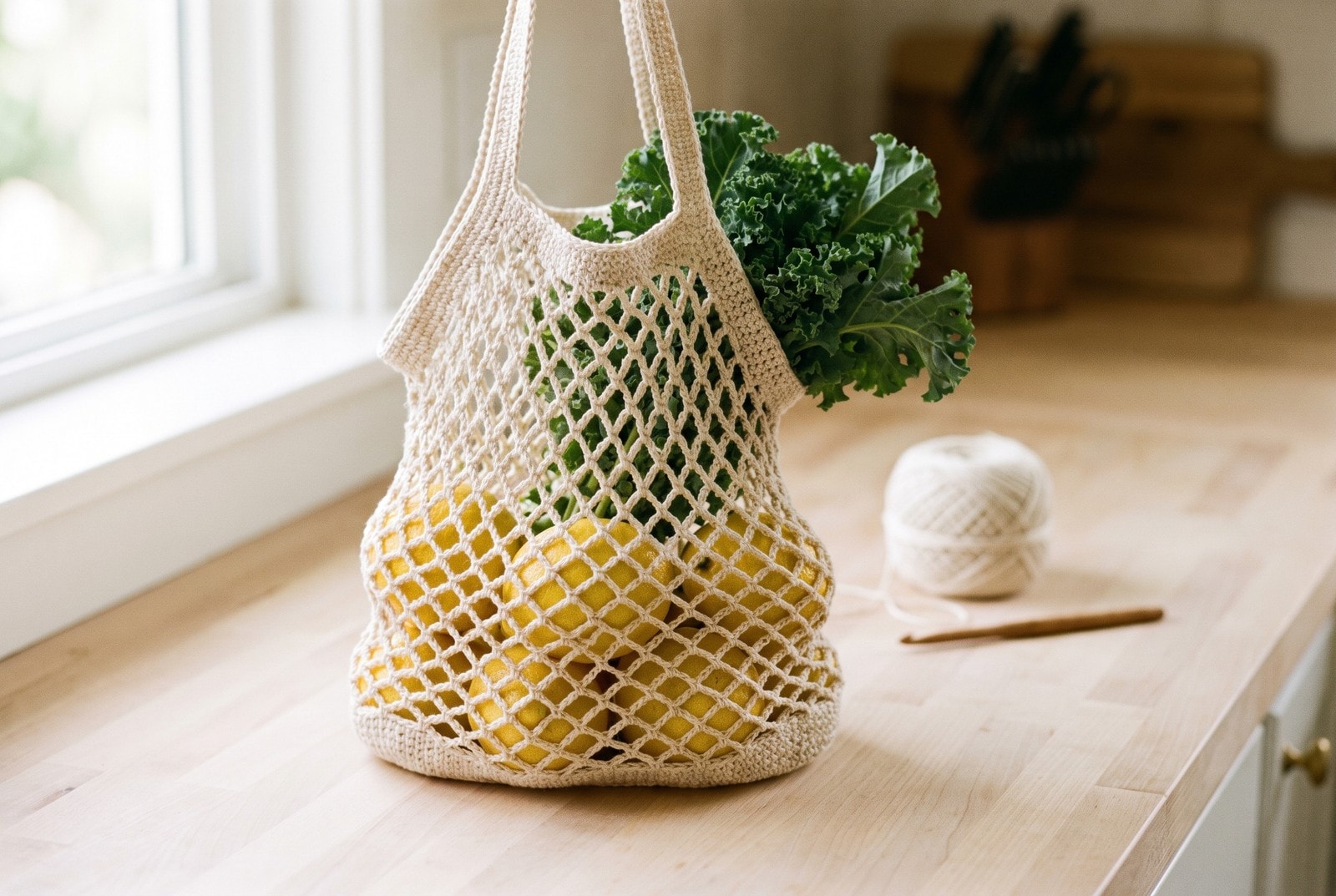
This market bag is worked from the base up in one piece: a firm flat circle in single crochet, then a chain mesh body worked in joined rounds, then a solid top band with the handles chained straight off it. There is nothing to sew.
Most bags in this category want a tight gauge so they hold their shape. A market bag is the exception — the mesh is meant to give, so the bag packs flat and then opens around whatever you put in it. What must not stretch is the base, which is why it is worked in dense single crochet on a hook a size down.
Why you’ll love this pattern
- The flat base is 7½ in / 19 cm across, so the bag stands up on a counter instead of slumping.
- A back-loop-only transition round makes a crisp fold line where the base meets the body.
- Handles are chained directly off the top band — no straps to sew on and nothing to work loose under load.
- One number changes the handle from a hand carry to an over-the-shoulder strap.
Instructions
- 1
Check gauge on the base fabric, not the mesh. Work a flat swatch in sc with the 4.0 mm hook: you want 16 sc x 18 rows = 4 in / 10 cm, and the fabric should feel stiff enough that you cannot easily push a finger through it. If it feels soft, drop to a 3.75 mm hook. Everything about whether this bag sags starts here.
- 2
Base. Make a magic ring. Rnd 1: 6 sc into the ring, do not join. (6 sts) Pull the ring closed and put your marker in the first stitch, moving it up as you begin each new round — the base is worked in a continuous spiral. Six increases per round is what keeps a single crochet circle flat: the circumference of a disc grows by a little over six stitch widths for every round you add.
- 348 sts
Rnd 2: inc in each st around. (12 sts) Rnd 3: (sc, inc) x6. (18 sts) Rnd 4: (2 sc, inc) x6. (24 sts) Rnd 5: (3 sc, inc) x6. (30 sts) Rnd 6: (4 sc, inc) x6. (36 sts) Rnd 7: (5 sc, inc) x6. (42 sts) Rnd 8: (6 sc, inc) x6.
- 496 sts
Rnd 9: (7 sc, inc) x6. (54 sts) Rnd 10: (8 sc, inc) x6. (60 sts) Rnd 11: (9 sc, inc) x6. (66 sts) Rnd 12: (10 sc, inc) x6. (72 sts) Rnd 13: (11 sc, inc) x6. (78 sts) Rnd 14: (12 sc, inc) x6. (84 sts) Rnd 15: (13 sc, inc) x6. (90 sts) Rnd 16: (14 sc, inc) x6.
- 5
Checkpoint: lay the base down without flattening it. It should sit flat as a disc about 7½ in / 19 cm across. A base that cups upward at the edge is short of stitches or worked too tight; a base that ripples like a frill has too many. This is the one measurement worth ripping back for, because the whole bag hangs off it.
- 6
Rnd 17 (transition): sc in BLO in each st around, then join with a sl st to the first sc. (96 sts) Working only the back loops folds the fabric on itself and leaves a visible ridge — that ridge is the corner where the base stops and the sides start, and it is what stops the base bowing outward when the bag is full. From here on, every round is joined rather than spiralled.
- 7
Rnd 18 (first mesh round): ch 1, sc in the same st. *Ch 4, skip 3 sts, sc in the next st.* Repeat from * around; on the last repeat, ch 4, skip the final 3 sts, and join with a sl st to the first sc. (24 ch-4 loops) The 96 base stitches divide evenly into 24 groups of 4, so this round comes out exact — if it does not, recount the base.
- 8
Rnd 19: sl st across into the centre of the first ch-4 sp. Ch 1, sc in that same sp. *Ch 4, sc in the next ch-4 sp.* Repeat from * around, join with a sl st to the first sc. (24 ch-4 loops)
- 9
Rnds 20-31: repeat Rnd 19 twelve more times, for 14 mesh rounds in total. Checkpoint: the mesh should measure about 10½ in / 27 cm from the base ridge to the last round when the bag is standing relaxed and not stretched. Add or leave out whole rounds here to change the depth — each round is about ¾ in / 2 cm.
- 10
Top band. Rnd 32: ch 1, work 4 sc into each ch-4 sp around, join with a sl st to the first sc. (96 sts) Rnds 33-35: ch 1, sc in each st around, join. (96 sts) Three solid rounds give the top edge enough body to carry the handles without the mesh distorting.
- 11
Handles. Rnd 36: ch 1, sc in the next 12 sts, ch 40 for a hand-carry handle (ch 76 for an over-the-shoulder handle), skip 24 sts, sc in the next 24 sts, ch 40 (ch 76), skip 24 sts, sc in the last 12 sts, join with a sl st to the first sc. The counts add up to all 96 stitches: 12 + 24 skipped + 24 + 24 skipped + 12, which puts the two handles exactly opposite each other.
- 12
Rnds 37-39: ch 1, sc in each st and in each ch around, join with a sl st. Fasten off after the final round. Working three rounds over the chain turns each handle from a single strand into a flat strap that will not twist or dig into a hand.
- 13
Finishing. Weave all ends into the solid base or the top band, never into the mesh — the mesh has nothing to grip and an end woven there works its way out. Wet the finished bag, squeeze out the water, then stretch it gently to shape and let it dry standing up over a bowl so the base sets flat. Measure it now: the bag should be about 11½ in / 29 cm tall and 12 in / 30 cm wide laid flat, opening to roughly 15 in / 38 cm deep when it is loaded.
| Round | Instruction | Stitch count |
|---|---|---|
| 1 | 6 sc into a magic ring | 6 |
| 2 | inc in each st | 12 |
| 3 | (sc, inc) x6 | 18 |
| 4 | (2 sc, inc) x6 | 24 |
| 5 | (3 sc, inc) x6 | 30 |
| 6 | (4 sc, inc) x6 | 36 |
| 7 | (5 sc, inc) x6 | 42 |
| 8 | (6 sc, inc) x6 | 48 |
| 9 | (7 sc, inc) x6 | 54 |
| 10 | (8 sc, inc) x6 | 60 |
| 11 | (9 sc, inc) x6 | 66 |
| 12 | (10 sc, inc) x6 | 72 |
| 13 | (11 sc, inc) x6 | 78 |
| 14 | (12 sc, inc) x6 | 84 |
| 15 | (13 sc, inc) x6 | 90 |
| 16 | (14 sc, inc) x6 | 96 |
| Handle | Chain length | Drop | Best for |
|---|---|---|---|
| Hand carry | 40 ch | 4 in / 10 cm | Carrying at your side, hooking over a wrist |
| Over the shoulder | 76 ch | 9 in / 23 cm | Walking home with both hands free |
Tips for success
- Work the base tighter than feels comfortable. It is the only part of this bag that carries load in shear, and a base crocheted at a relaxed tension will bow into a bowl the first time you put four apples in it.
- Count the base rounds out loud as you go. Every round adds exactly 6 stitches, so a finished round always lands on a multiple of 6 — if it does not, you have found the error while it is still one round old.
- Weave the starting tail of the magic ring in before you get past Rnd 6. Once the base is 60 stitches wide it is awkward to turn over, and a magic ring that works loose under load takes the centre of the base with it.
- Leave the bag out of the tumble dryer. Cotton mesh recovers from stretching when it air-dries flat, but heat sets whatever shape it dried in.
Pattern at a glance
- Time to make
- Two evenings
- Skill level
- Easy
- Hook
- 4.0 mm (G/6)
- Yarn weight
- Worsted (CYC 4) cottonCYC standard
- Yardage
- About 220 yd / 200 m worsted-weight cotton
- Gauge
- Base: 16 sc x 18 rows = 4 in / 10 cm, worked firmly
- Finished size
- Base 7½ in / 19 cm across. Body 11½ in / 29 cm tall and 12 in / 30 cm wide laid flat, opening to about 15 in / 38 cm deep loaded. Handle drop 4 in / 10 cm (hand) or 9 in / 23 cm (shoulder).
Free ebook
Get new patterns, and the ebook
New patterns as they land, plus our free beginner's crochet stitch guide. No daily blasts, unsubscribe in one click.
Frequently Asked Questions
Why is my base cupping upward at the edges?
You are one or more increases short. A flat circle in single crochet needs exactly 6 increases per round, evenly spaced, so every finished round lands on a multiple of 6. Count the last round: if it is under, the circumference is too small for the number of rounds you have worked and the edge has no choice but to pull up into a bowl. The opposite error, a rippling frill, means you added too many.
Can I make this in acrylic instead of cotton?
Not for a bag that carries weight. Acrylic has almost no recovery under sustained load, so the mesh stretches once and stays stretched, and the handles lengthen every time you fill it. Cotton, jute, hemp and t-shirt yarn all hold their shape. Save the acrylic for something that is not asked to carry groceries.
How do I make the bag bigger?
Keep adding base rounds in the established pattern — Rnd 17 is (15 sc, inc) x6 for 102 stitches, Rnd 18 is (16 sc, inc) x6 for 108 — until the base is the diameter you want. Stop on a count divisible by 4 so the mesh round still divides evenly: 108 works and gives 27 loops, 102 does not. Add mesh rounds for depth at about ¾ in each.
Does this bag need a lining?
No, and lining it would defeat the point. A lining is worth adding to a bag that carries keys, pens and coins, because crochet fabric has gaps those fall through. This one is deliberately open mesh for produce and bulky items, so anything small enough to fall through the mesh belongs in a different bag.